Home › News › Chain-Reaction Crash on I-75 Near Ringgold, Georgia: How Insurance Sorts Out Who Pays
Chain-Reaction Crash on I-75 Near Ringgold, Georgia: How Insurance Sorts Out Who Pays
When several cars collide within seconds of each other, the hardest part often comes later: working out who is responsible for which damage and whose insurance pays. A recent series of collisions on Interstate 75 in north Georgia shows how messy that can get, and why the coverage you choose before a crash matters.
What happened on I-75 near Ringgold
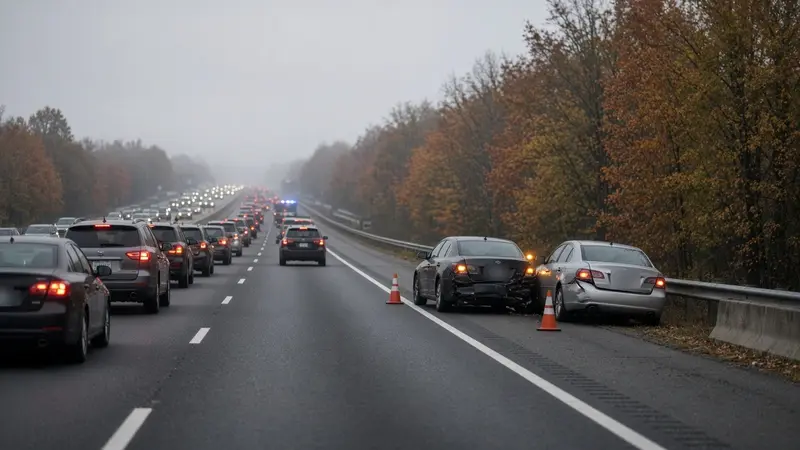
On the morning of Wednesday, October 7, 2026, northbound I-75 near Ringgold, Georgia, close to the Tennessee line, was shut down for roughly an hour and a half. According to the Georgia State Patrol, as reported by Local 3 News, it was not a single crash but three related ones between mile markers 347 and 348.
The sequence began when a pickup truck hit the back of a sedan. Separately, a sedan sideswiped another car. With the middle and left lanes blocked, traffic began to back up, and in that slowdown a station wagon struck the rear of a tractor-trailer. The driver of the station wagon was taken to the hospital with serious injuries.
Troopers cited two drivers: the pickup driver for following too closely and one of the sedan drivers for an improper lane change. The collision involving the tractor-trailer was still under investigation at the time of the report.
We won't speculate about anyone involved. But an event with several impacts, several drivers, and a commercial truck is exactly where insurance gets confusing. Here is a plain-English walk-through.
Source: UPDATE: 1 hospitalized, 2 cited after chain-reaction crash on I-75 near Ringgold, Local 3 News (citing the Georgia State Patrol), October 7, 2026. Basic facts are summarized from that report; this explainer is our own writing.
Why chain-reaction crashes are harder to sort out
- Each impact may be its own claim. Adjusters and police look at the order of events: who hit whom, when, and why. The driver who started the first collision is not automatically responsible for a later one that happened in the backup.
- Rear-end collisions often point to the rear driver, but not always. Drivers are expected to leave enough room to stop, so the car that hits another from behind is frequently found at fault. That changes if a car was pushed forward by another vehicle, or if someone cut in sharply and braked.
- A citation is evidence, not the final word. A ticket for following too closely or an improper lane change carries weight with insurers, but fault for insurance purposes is decided through the claims process, and sometimes in court.
- A commercial truck brings in a commercial policy. When a tractor-trailer is involved, the trucking company's insurer usually becomes part of the claim.
What to do right after a multi-car crash
- Check for injuries and call 911. On a highway with several vehicles involved, assume police and medical help are needed.
- Get out of danger if you can. Many states ask drivers in minor, injury-free crashes to move their vehicles out of travel lanes when it is safe. If your car cannot move and the shoulder is not safe, staying buckled in with your hazard lights on is often safer than walking near moving traffic.
- Exchange information with every driver you made contact with, not just the one who hit you first: name, phone, insurer, policy number, and vehicle description.
- Document the scene. Take photos of every vehicle involved, where they came to rest, lane positions, damage, skid marks, and weather or road conditions. Write down whether your car was hit more than once.
- Ask for the crash report number and the name of the agency that responded. Your insurer will want it.
- Report the crash to your insurer promptly, even if you think another driver is at fault. Most policies require timely notice.
- Get checked by a doctor. Some injuries are not obvious right away, and medical records help support an injury claim.
How auto insurance typically handles a pileup
Liability coverage: the at-fault driver's policy
Georgia, like most states, uses an at-fault (tort) system: the driver responsible for a collision is responsible for the resulting injuries and damage, and that driver's bodily injury and property damage liability coverage pays the other people involved. Georgia's legal minimums are $25,000 per person and $50,000 per accident for bodily injury and $25,000 per accident for property damage, according to the Georgia Office of Commissioner of Insurance. Those limits apply per accident, so in a multi-car crash several people may have to share one driver's limits.
Collision coverage: your own car, regardless of fault
Collision pays to repair or replace your vehicle after a crash, minus your deductible, whoever caused it. That can be the fastest route when fault is still being sorted out. Your insurer may then pursue the at-fault driver's insurer for reimbursement (a process called subrogation), and if it recovers the money, you may get your deductible back.
Uninsured and underinsured motorist coverage
If the driver who hit you has no insurance, or not enough to cover your losses, uninsured/underinsured motorist (UM/UIM) coverage on your own policy can fill the gap. Georgia's insurance office notes that insurers must offer UM coverage, which can also apply to hit-and-run crashes. In a pileup where one driver's limits are split many ways, UIM can matter a lot.
Medical payments (MedPay) and PIP
MedPay is optional coverage that helps pay medical bills for you and your passengers regardless of fault. In no-fault states such as Florida, Michigan, and New York, personal injury protection (PIP) plays a similar role and is required. Georgia is not a no-fault state, so MedPay there is an add-on worth asking about.
When a commercial truck is involved
Interstate trucking companies must carry much higher liability limits than private drivers. Under federal rules, many for-hire carriers of general freight need at least $750,000, according to the Federal Motor Carrier Safety Administration. These claims can be complex, and many people talk with an attorney.
Shared fault
States split shared blame differently. Under Georgia's modified comparative negligence rule, your recovery is reduced by your share of fault, and you cannot recover if you are found 50% or more at fault. Some states use pure comparative fault, and a few, including North Carolina, Virginia, and Maryland, still use contributory negligence, where even slight fault can block recovery.
Common mistakes after a chain-reaction crash
- Assuming the last car in line pays for everything. Each impact is evaluated on its own.
- Only collecting information from one driver. If you were struck twice, you may have two claims.
- Admitting fault or guessing at the scene. Stick to facts with police and other drivers.
- Skipping a medical check. Gaps in treatment can make injury claims harder. Also report the crash promptly; delays can complicate a claim.
- Carrying only state-minimum limits without thinking about it. Minimums can run out quickly when several people are hurt or several cars are damaged.
Is your auto coverage ready for a crash like this?
A pileup is a good reminder to look at your policy before you need it: your liability limits, whether you have collision, how high your deductible is, and whether you carry UM/UIM and MedPay. A licensed agent can walk you through those options and compare car insurance quotes with you in one free call at (888) 217-5854.
FAQ
If I was rear-ended and pushed into the car in front of me, who pays?
Often the driver who hit you from behind is treated as responsible for both impacts, because your car did not move on its own. Insurers look at the evidence, so photos, witness information, and the police report help. Your collision coverage can repair your car while fault is sorted out.
Does a traffic ticket decide who is at fault?
Not by itself. A citation is strong evidence, but fault for insurance purposes is determined in the claims process, and the final say can come from a court.
Will my insurance rates go up if I wasn't at fault?
It depends on your insurer and your state. Insurers generally focus on accidents you caused when setting rates, and some states limit surcharges for accidents that were not your fault. Ask an agent how a specific carrier treats them.
What if the at-fault driver's insurance limit runs out?
If several people share one driver's limits, there may not be enough to go around. Underinsured motorist coverage on your own policy can help cover the gap, up to your limits.
Important: This article is general information, not legal, tax, or insurance advice, and coverage rules vary by state, insurer, and policy. AutoInsuranceBundle.pro is a free, independent insurance comparison and referral service. We are not an insurance company, we do not issue policies, and we do not provide insurance advice. Calls to the number on this site are routed to licensed insurance agents or agencies in our partner network, who may receive compensation. Calling is completely voluntary and there is no obligation to buy. Rates, discounts, and availability vary by carrier, state, and individual eligibility; not all carriers, products, or discounts are available in all states. Calls may be recorded for quality and compliance purposes.